Separation and divorce rearrange almost every part of daily life: where children sleep, who pays which bills, what happens to the family home, how pensions are shared, and when someone is free to remarry. People in Victoria often type “divorce lawyer” into a search bar while they are still deciding whether they have even separated yet. Others arrive after months of informal arrangements that suddenly stop working. This page explains how separation and divorce work in British Columbia, what usually must be resolved before an uncontested divorce can proceed, how contested files differ, and how common-law relationships fit into the same landscape. The goal is practical clarity—not scare tactics, not American “lawyer” framing, and not outcome guarantees.
Family law in this province sits primarily under the provincial Family Law Act and, for the divorce order itself and some parenting language for married spouses, the federal Divorce Act. You do not need to master every section before asking for help. You do need a working map of the decisions ahead so you can use a consultation well and avoid expensive false starts.
Separation date and why it matters
In Canada, most divorces proceed on the ground of marriage breakdown after spouses have lived separate and apart for at least one year. You can be separated while still sharing a residence if you are living separate lives—for example, separate bedrooms, separate finances, and an end to presenting yourselves publicly as a couple. The date of separation is more than a calendar curiosity. It can affect property valuations, support analysis, and how long you wait before a divorce order is available on the one-year ground.
There is no single government form you file simply to “register” a separation. What matters is the factual reality of the breakdown. Evidence of separation can include:
- Telling friends and family you have separated
- Opening individual bank accounts
- Stopping joint budgeting
- Changing day-to-day routines and how you present as a couple
Because memories diverge under stress, write down the date you believe separation began and the facts that support it. If you and your spouse disagree about the date, that disagreement itself can become a contested issue with financial consequences.
Adultery and cruelty are also grounds for divorce under federal law. Many people still choose the one-year separation path because proving fault can be slower, more expensive, and more conflictual, and because the practical work of parenting and property still has to be done either way. Process choice should be discussed with counsel based on your evidence, safety needs, and goals.
Emotional separation versus legal separation
Couples sometimes say they “grew apart years ago” but continued filing taxes together, sharing a bedroom occasionally, or holding out hope of reconciliation. Courts look at the whole picture. If you are unsure whether you have separated for legal purposes, treat that uncertainty as a reason to get advice before selling assets, moving children, or signing private IOUs.

Uncontested (desk-order) versus contested divorce
Only a court can grant a divorce. Agreement alone does not dissolve a marriage. In British Columbia that usually means a Supreme Court process. If you and your spouse agree on parenting, child support, spousal support, and property or debt division—or those issues have already been resolved by agreement or order—you may be able to proceed with an undefended or “desk-order” divorce. A judge or associate judge reviews filed materials without a trial appearance when the paperwork is complete and the arrangements appear appropriate, especially regarding children.
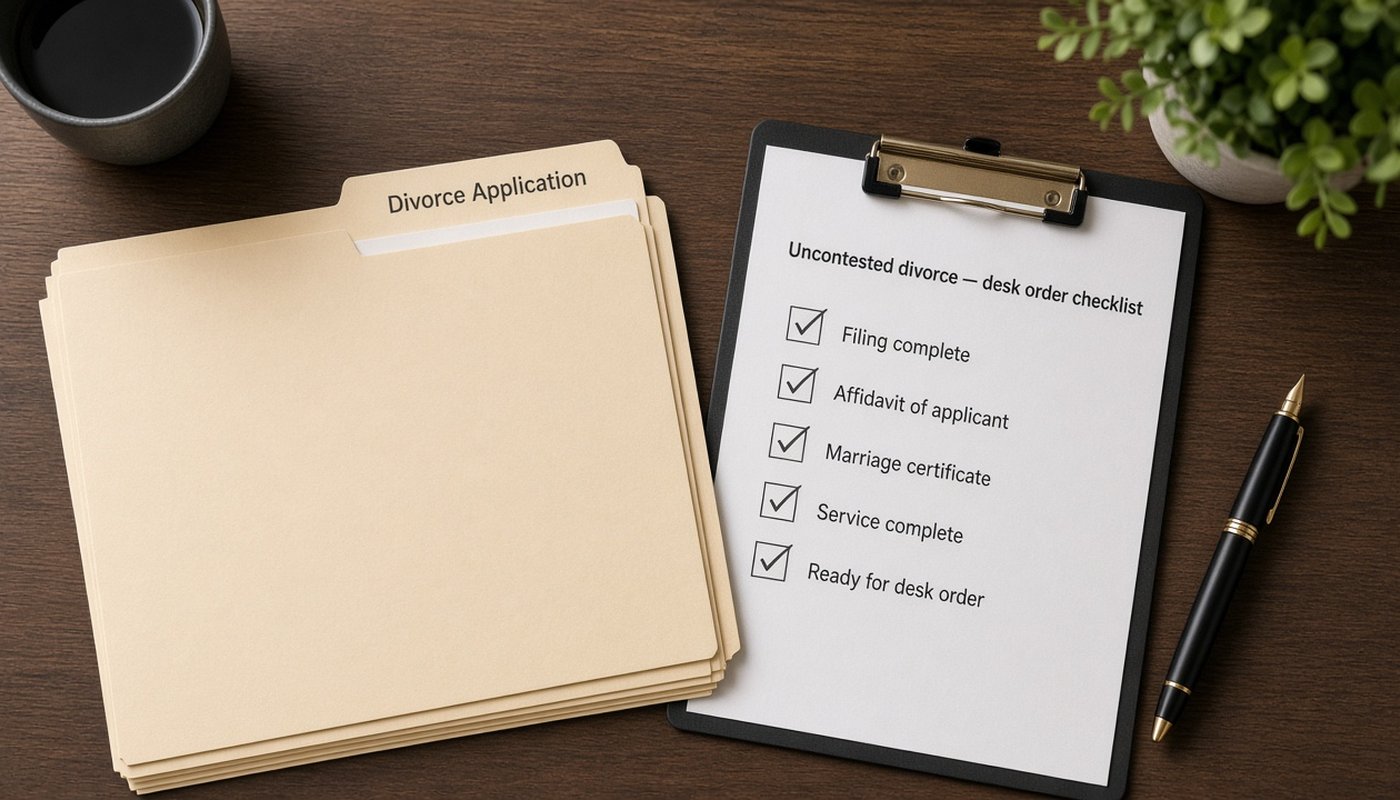
A contested divorce is different. Contested does not always mean a multi-week trial on day one. It means one or more issues remain in dispute and the file may require applications, judicial case conferences, financial disclosure fights, negotiations under pressure, or hearings. Cost and timeline expand with the number of issues and the intensity of conflict. Public BC guidance notes that complex divorces can become very expensive; industry commentary often contrasts a few thousand dollars of lawyer fees for cooperative uncontested work with retainers that climb quickly when parenting and property are fought hard.
What “agreed” really means
Verbal understandings collapse. Courts and future you need written terms that can be followed: parenting schedules, decision-making rules, support numbers, payment dates, property transfers, refinancing deadlines, and debt responsibility. If children are involved, child support arrangements generally need to be clear before a final divorce order is granted. “We’ll figure out the house later” is not a plan; it is a future dispute.
Joint filings and sole applications
Public self-help resources describe joint family claim pathways when both parties agree from the start, as well as sole applications that may proceed as undefended if the other party does not respond or withdraws opposition. Each path has trade-offs around service of documents and flexibility if agreement breaks down. Counsel can help you choose the path that matches how much trust remains between you.
Do you need a separation agreement?
A separation agreement is not strictly mandatory to obtain a divorce in British Columbia. The more precise answer is that the court still needs to see that family law issues—especially reasonable financial arrangements for children—are properly addressed. A carefully drafted, signed separation agreement is the most common way to show that. Parenting and support terms in a filed agreement can also become easier to enforce.
People sometimes ask whether they can “just get divorced” and sort money later. That approach creates risk. Property and support rights have limitation periods and proof problems. Waiting can freeze people in conflicted housing or parenting patterns. Even amicable couples benefit from converting goodwill into clear writing while communication still works. DIY templates miss pensions, stock options, trust interests, or tax consequences that matter in real Victoria households with small businesses, farms, or cross-border work histories.
Independent legal advice
Agreements are stronger when each party understands what they are signing. Independent legal advice is often recommended or expected for serious family agreements. One lawyer cannot advise both spouses. If someone asks you to sign quickly “to keep the peace,” slow down and get advice.
Issues usually resolved before the divorce order
Divorce paperwork is often the last step, not the first. Most of the hard work sits in four buckets that interact with each other:
- Parenting: parenting time, parental responsibilities, holidays, travel, and communication.
- Child support: Federal Child Support Guidelines table amounts and special or extraordinary expenses.
- Spousal support: whether it is payable, how much, and for how long.
- Property and debt: family property, excluded property, pensions, businesses, and who refinances or sells what.
If you are researching only the divorce order, pause and inventory these issues. A Victoria family lawyer consultation is often most useful when you arrive with that inventory, even if the numbers are incomplete. Link your reading to our pages on parenting, support, and property division so the strategy stays coherent.
Common-law relationships and the two-year rule
In British Columbia, people who have lived together in a marriage-like relationship for at least two years generally have Family Law Act rights regarding family property and spousal support that many people associate only with marriage. Parenting responsibilities can arise regardless of marriage. This surprises clients who moved from provinces with different rules or who relied on older myths that “common law means nothing.”
If you are unmarried and separating in Victoria, do not assume you have no claim—or that you automatically have every claim. Dates of cohabitation, whether the relationship was marriage-like, contributions to a home titled in one name, and what property existed before the relationship all matter. Limitation periods can run from separation for unmarried spouses. Get advice promptly if property or support is in play.
Documents that usually matter
For an uncontested divorce path, public self-help materials commonly require an original marriage certificate or certified registration (not merely a ceremonial keepsake), identification, and evidence of agreements or orders dealing with children and finances. Affidavits set out sworn facts for the court. If you have dependent children, a child support affidavit is typically part of the package. Registry staff may check completeness; a judge may request more information or an appearance if something is missing or unclear.
Parallel to the court forms, practical financial disclosure usually includes:
- Tax returns and notices of assessment
- Pay stubs or company statements for self-employment
- Mortgage balances, property assessments, or appraisals
- Pension summaries
Organizing these early reduces cost whether you settle or litigate. Missing disclosure is one of the most common reasons cooperative files turn expensive.
Timelines people ask about
The one-year separation period is a floor for many divorce orders on marriage breakdown, not a promise that paperwork finishes on day 366. Desk-order processing times vary with registry workload and document quality. Contested files can take many months or longer. Meanwhile, interim parenting and support arrangements may still be needed so children’s lives stay stable and bills are paid. Think in phases: stabilize, disclose, negotiate or adjudicate, then finalize the divorce order when corollary issues are ready.
When your spouse will not cooperate
“Uncontested” requires enough agreement or a procedural path where the other party’s non-response allows an undefended process. If your spouse refuses to negotiate, hides assets, or ignores children’s needs, the file may need formal steps: service of documents, applications for interim orders, disclosure demands, or court attendance. That does not mean every dispute must become scorched-earth litigation. It does mean hoping silently rarely fixes a stuck file. Document attempts to resolve issues calmly; tone in writing matters later.
Safety, urgency, and interim needs
Some separations involve intimidation, financial control, or risk of harm. Those facts should lead the conversation. Protection-related steps, safe communication channels, and urgent parenting or support applications may take priority over long-term property negotiations. This website is not a crisis service; if you are in immediate danger, contact emergency services. For non-emergency legal planning, tell counsel about safety concerns early so process choices fit reality.
How counsel can help on a divorce or separation file
Depending on confirmed scope after intake, counsel may help you identify separation-date evidence, choose negotiation or mediation pathways, draft or review a separation agreement, model support scenarios, organize financial disclosure, and prepare divorce filings. Whether this practice acts as a mediator, represents you in mediation, or both remains hold for verification. Consultation pricing and retainer structure also remain hold for verification.
What we will not do is publish competitor promises as our own, invent years of experience, or guarantee a result. Family law outcomes turn on facts, evidence, the other party’s behaviour, and judicial discretion.
Comparing quotes and process options
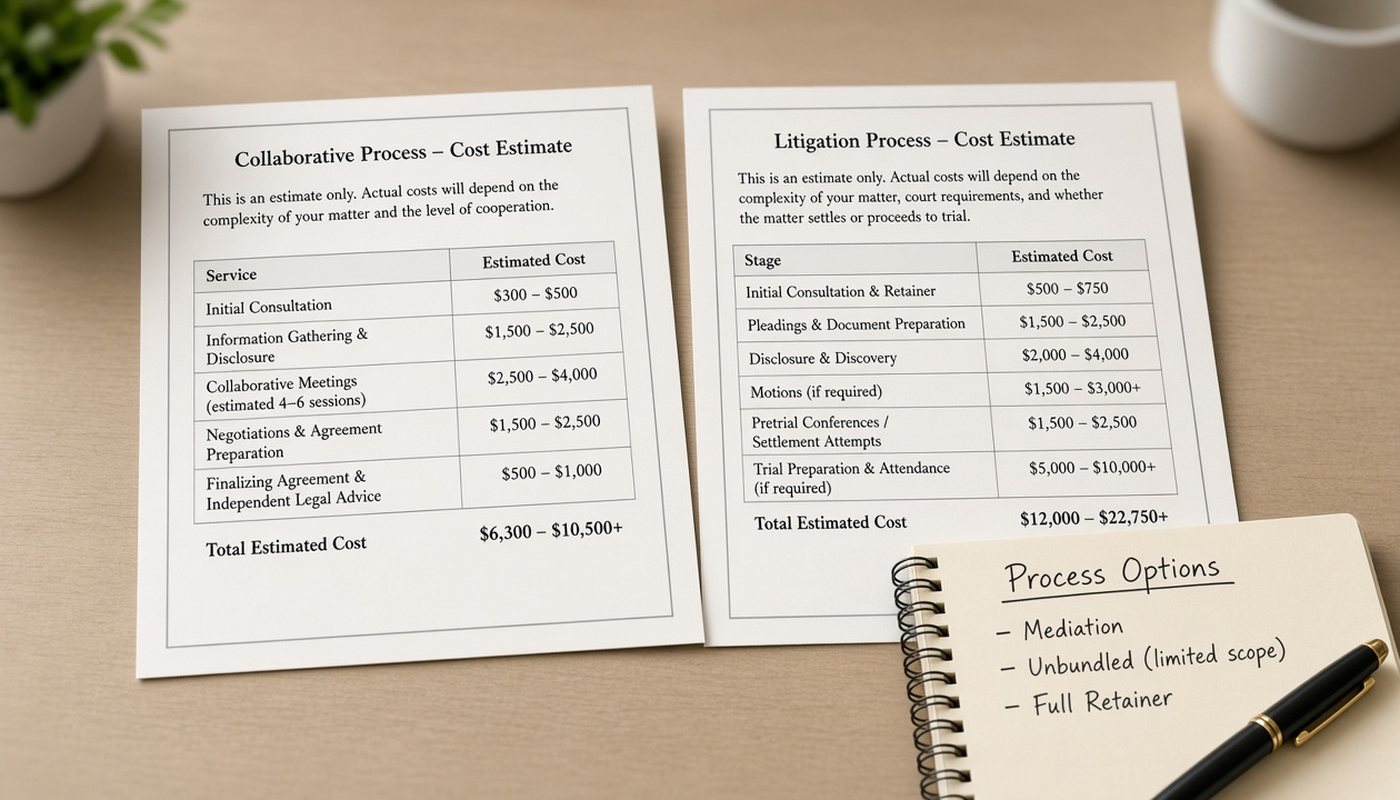
When you speak with any BC family lawyer, ask what is included in a flat fee, what disbursements are extra, how often you will be billed on an hourly retainer, and who will actually do the work. Ask how they approach disclosure deadlines and communication with the other side. Cheapest is not always lowest total cost if the agreement has to be rebuilt later. Most expensive is not automatically best. Fit, clarity, and a realistic plan matter more than slogans.
Divorce and Separation FAQs
What’s the difference between separation and divorce in B.C.?
Separation is when your relationship ends and you begin living separate lives. Married and unmarried couples can separate without a court order. Divorce is a court order that legally ends a marriage. Parenting, support, and property issues can arise as soon as you separate.
Can we be legally separated while living in the same house, and how do we establish the separation date?
Yes. You can separate under the same roof if the intention to end the relationship is communicated and acted on. A dated message, changes to sleeping arrangements or household routines, and how you handle expenses can help show when the separation began. Keep a record if you expect the date to be disputed.
Do I have to wait a full year after separating before I can file for divorce?
When you rely on separation as the ground for divorce, you can start a divorce proceeding before the year is up. The court can grant the divorce once you’ve been separated for at least a year. If you’re using B.C.’s online joint-divorce process, you can prepare the forms sooner and file the documents for that process after the year has passed.
How do I file for divorce in Victoria, and what if my spouse lives outside B.C.?
You file through BC Supreme Court. The forms and next steps depend on whether you file jointly or start the claim yourself. Generally, at least one spouse must have been habitually resident in B.C. for the year immediately before filing. If your spouse lives elsewhere, check the service rules before arranging delivery, especially if they live outside Canada.
How does an uncontested, or desk-order, divorce work in B.C.?
You submit the required forms, affidavits, and proposed order to BC Supreme Court for a judge to review, usually without a hearing. A desk-order divorce can proceed by joint application or, where the procedural requirements are met, after one spouse files and the other doesn’t contest it. If you have children, the court must be satisfied that reasonable child support arrangements are in place.
How long does a divorce take in B.C.?
Timing depends on whether there’s a dispute, how quickly the paperwork and service are completed, and how long the court takes to review the file. If separation is the ground, allow for the one-year separation requirement. A divorce generally takes effect on the 31st day after the court grants it, so factor that in if you plan to remarry.
How much does a divorce cost in Victoria, including filing fees?
Court filing and registry fees apply and change over time—confirm current amounts with the BC Supreme Court registry. Lawyer fees depend on whether parenting, support, and property are already resolved, how much remains contested, and whether work is billed hourly, flat, or limited-scope. Uncontested desk-order files with settled issues usually cost far less than contested litigation. This firm’s quote remains hold for verification.
Can I get divorced if my spouse won’t sign the papers or respond?
Yes. You can start a divorce claim yourself and arrange for your spouse to be properly served. If they don’t respond within the applicable time, you may be able to ask for an uncontested order. If they dispute the claim or you can’t locate them for service, you may need additional steps before the court can proceed.
Do I need a separation agreement, and what should it cover?
A written agreement can record how you’ll handle parenting, child support, spousal support, the family home, debts, pensions, and other assets. It can also set dates for exchanging financial information or reviewing support. Before signing, exchange the relevant financial records and consider getting separate legal advice so each person understands what they’re agreeing to.
What should I do first if we’ve just separated and still share a home, bills, or childcare?
Record the separation date, gather copies of important financial records, and work out a temporary plan for childcare and essential bills if it’s safe to do so. Note which decisions still need to be made about the home and your finances. Get advice before making major changes such as withdrawing joint funds, moving with the children, or signing a final agreement.
General information about British Columbia family law for readers in Victoria. Not legal advice. Firm-specific credentials, languages, fees, and process promises remain hold for verification.