For many separating couples in Victoria, the family home, pensions, and household debt are the centre of the dispute. British Columbia’s Family Law Act sets out a structured approach to family property and family debt for married spouses and for unmarried spouses who have lived in a marriage-like relationship for at least two years. This page explains who the rules apply to, how family property differs from excluded property, what happens to pensions and RRSPs, why disclosure matters, and how agreements compare with court. It also briefly notes companion animals, which the province treats as a unique category of property.
Property division is technical. Titles on land, beneficiary designations, and corporate shareholdings can diverge from family-law entitlements. Do not assume that “whose name is on it” ends the analysis.
Who the rules apply to
Provincial guidance is clear: rules about dividing family property apply to married couples and to unmarried couples who have lived together in a marriage-like relationship for at least two years. Once that threshold is met, the relationship timeline often runs from the start of cohabitation for certain calculations. Couples can make agreements that opt out of or customize default rules, but those agreements need careful drafting and usually independent legal advice to stand up later.
If you separated before two years of cohabitation and have no children or other special factors, property claims may look different. Parenting and child support can still apply. Get advice based on your dates rather than a friend’s story from another province.

Family property versus excluded property
Family property generally includes property owned by either spouse on the date of separation—home, bank accounts, investments, insurance policies, pensions, and business interests—regardless of whose name appears on title. It also includes the increase in value of excluded property during the relationship. On separation, each spouse is generally entitled to an undivided half interest in family property and equally responsible for family debt, subject to agreements or a finding that equal division would be significantly unfair.
Excluded property typically includes property acquired before the relationship began, inheritances, and many gifts from third parties, among other categories set out in the statute. The spouse claiming an exclusion must prove it. Tracing matters: if excluded funds are mixed into a joint account or used to pay the mortgage, the analysis can become complex. Growth in value of excluded property during the relationship is generally shareable even when the original excluded value is not.
A plain example
Provincial public materials illustrate the concept with a home owned before cohabitation that rises in value during the relationship: the pre-relationship value may remain excluded while the increase is shared. Real files add mortgages, renovations, and down-payment tracing. Treat examples as teaching tools, not valuations of your house.
Pensions, RRSPs, and retirement accounts
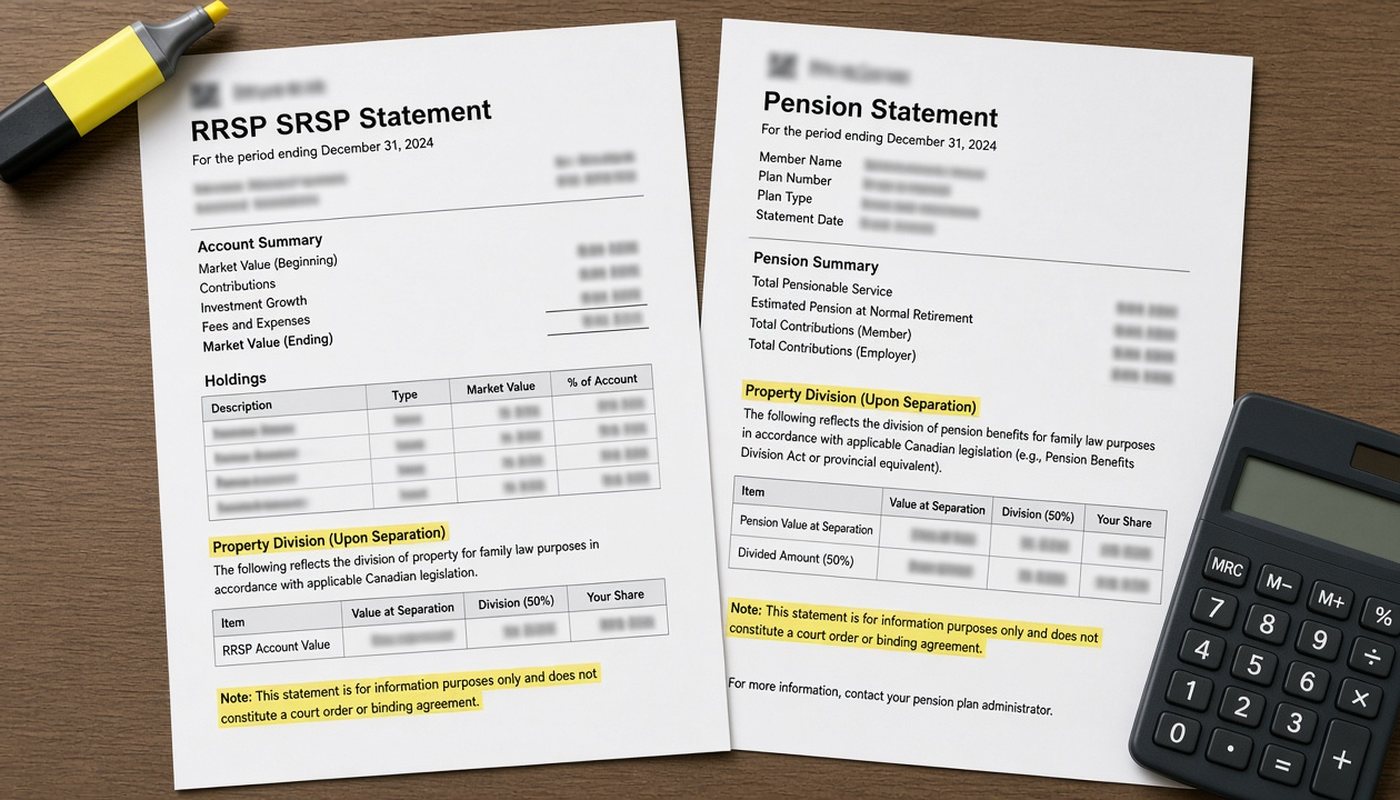
Pension entitlements are often family property to the extent they relate to the relationship period. Division can involve plan administrators and specific statutory rules. RRSPs and similar accounts also need careful handling for tax and transfer mechanics. Do not cash out retirement savings casually to “settle” a dispute without advice; tax and early-withdrawal costs can destroy value both spouses need.
Gather annual pension statements early. Some plans take months to produce formal valuations. Starting late creates settlement bottlenecks.
Family debt
Family debt generally includes debt incurred by a spouse during the relationship and certain post-separation debts incurred to maintain family property. Lines of credit, joint credit cards, vehicle loans, and income-tax debts can all appear. Equal responsibility is the starting point, subject to agreements or significant unfairness arguments. Separating spouses should avoid new discretionary debt and should document what existed at separation.
Disclosure and valuations
You cannot divide what you have not listed. Full financial disclosure is both a legal expectation and a practical necessity. Hide-and-seek strategies increase cost and risk unequal division consequences or cost awards in some contexts. Appraisals for real estate, business valuations, and pension valuations should be proportionate to the asset’s size. Fighting over a used sofa while ignoring a business interest is a common imbalance of energy.
Self-employed spouses should expect questions about corporate expenses and personal benefits. Bring your bookkeeper or accountant into the process early when numbers are messy.
Agreements versus court
Most property files resolve by agreement: separation agreement, consent order, or both. Court remains available when disclosure fails, valuations diverge wildly, or one party refuses reasonable settlement. Equal division is the norm; unequal division requires meeting the “significantly unfair” threshold, which public materials describe as uncommon. Negotiation should still be principled, not wishful.
Interim exclusive occupancy of a home, sale orders, and preservation orders are sometimes needed while the larger case proceeds. Strategy depends on children’s needs, carrying costs, and whether the home is financeable by one spouse alone.
Companion animals
British Columbia treats companion animals as a unique type of property with specific factors for possession and ownership after separation. Spouses may agree to share possession, or a court may order sole ownership or possession. Pets are emotionally charged; plan for them explicitly in agreements rather than leaving them as an afterthought that reopens conflict.
Businesses, farms, and professional practices
Victoria and the wider Capital Regional District include agricultural operations, trades companies, and professional practices. Business interests can be family property even if only one spouse is active in the business. Valuation methods, tax on extraction, and ongoing management during separation need coordinated legal and financial advice. Non-owning spouses should not be dismissed with “you never worked there.” Owning spouses should not assume the business is untouchable.
Limitation periods and timing
Claims related to property and support can be subject to time limits that run differently for married and unmarried spouses. If you have been separated for a long time without formalizing property division, seek advice promptly. Delay can shrink options even when relationships remain civil on the surface.
How property connects to support and divorce
Who keeps the house affects monthly budgets and spousal support analysis. Selling versus buyouts affects liquidity for legal fees and relocating with children. Property settlement is often a prerequisite to an efficient uncontested divorce. See support, divorce, and parenting for the related moving parts. Mediation can unlock property deals when valuations are shared; see mediation.
Preparing a property inventory
Prepare a property inventory that includes:
- Land, vehicles, bank and investment accounts
- Pensions, crypto, and other valuable goods
- Every debt, with approximate balances at separation and today
- Inheritances and pre-relationship assets you may claim as excluded
Photograph serial-number items if misuse is a concern. A clean inventory shortens consultations and reduces hourly burn later.
The family home: sell, buy out, or hold temporarily
The home is usually both an asset and a child’s stability base. Options typically include listing for sale, one spouse buying out the other, or a short-term co-ownership arrangement with clear rules on carrying costs, occupancy, and a drop-dead sale date. Informal “you stay, I’ll move out, we’ll see” arrangements create resentment when repair bills and mortgage payments fall unevenly.
Financing a buyout depends on income, credit, and lender rules after separation. Get mortgage pre-approvals early if a buyout is your goal. If sale is inevitable, agree on listing agents, price reductions, and how showings work when children still live there. Document personal belongings before move-out day to avoid petty spiral conflicts that derail larger settlements.
Vehicles, household goods, and digital assets
Also inventory:
- Vehicles—transfer title and loans together
- Household goods (keep disputes proportionate)
- Digital assets: domain names, crypto wallets, online accounts, photo libraries
- Passwords and two-factor authentication access
Address these items in the agreement so they do not reopen conflict later.
Rewards points, season tickets, and club memberships have value. If they matter to you, list them. If they do not, release them quickly and save fees for pensions and land.
Trusts, gifts from parents, and family loans
Victoria families sometimes receive down-payment help from parents documented poorly as either a gift or a loan. Characterization changes exclusion analysis and debt division. Promissory notes, bank trails, and contemporaneous messages help. After separation, new “loans” from relatives can look strategic; expect scrutiny. Transparency beats creative paperwork invented after the fact.
Trust interests raise specialized issues under the Family Law Act. If either spouse is a beneficiary of a discretionary trust, tell counsel early so expectations remain realistic.
Negotiation sequence that usually works
List assets and debts, gather statements, identify claimed exclusions, value the major items, then trade. Jumping to “I get the house” before valuations invites deadlock. Using mediation after disclosure packages are exchanged is often more productive than mediating in the dark. Court applications to compel disclosure may be needed when one party stalls; that cost should be weighed against the size of the missing asset.
Settlement offers should include implementation steps: transfer deadlines, indemnity for debts, refinancing dates, and what happens if a party misses a deadline. An agreement without an implementation calendar is a future chambers application waiting to happen.
Credit scores, refinancing, and joint accounts
Separation does not automatically freeze joint credit. Either party might draw on a joint line if it remains open. Speak with your bank about practical steps available to you and get legal advice before unilateral moves that could breach duties. After settlement, refinancing and removing a spouse from title or loans should follow the agreement’s deadlines closely. Leaving joint debt alive “for a while” is how people inherit each other’s post-separation spending.
Monitor your credit report during the transition. Unexpected applications or missed joint payments deserve quick attention, not embarrassment-driven delay.
Victoria readers should also remember that online calculators and out-of-province blog posts can misstate British Columbia rules. When something important turns on a number or a deadline, confirm it against current BC sources or advice grounded in this province. A careful hour of verification is cheaper than a year of fixing a mistaken assumption. If you are ready to apply these ideas to your facts, use the consultation request form and list the documents you already have.
Keep notes after every negotiation or mediation session while details are fresh. Those notes become the backbone of a cleaner agreement and a shorter consultation next time you need one.

Property Division FAQs
Is everything split 50/50 after separation in B.C., including debts?
Equal division of family property and family debt is the usual starting point for qualifying spouses. Some assets, such as certain gifts or inheritances, may be excluded, although an increase in their value can be shared. An enforceable agreement can set different terms, and a court can order unequal division where equal division would be significantly unfair.
Do common-law partners have the same property rights as married spouses in B.C.?
B.C.’s family property rules generally apply to unmarried partners who lived together in a marriage-like relationship for at least two years. That can give qualifying partners property and debt rights similar to those of married spouses. The filing deadlines are different, so confirm the date your relationship began and the date you separated.
Who can stay in the family home after separation if only one spouse is on title?
Being on title doesn’t necessarily determine who can occupy the home while property issues are being resolved. In appropriate circumstances, a qualifying spouse can ask BC Supreme Court for temporary exclusive occupation. That addresses who can live there for the time being. Ownership and the final division of equity are separate decisions.
How does a house buyout work, and how do I get my name off the mortgage?
A buyout usually starts with agreeing on the home’s value and confirming the mortgage balance. From there, you calculate equity and negotiate the amount one spouse will pay, taking any agreed property adjustments into account. Coordinate the title transfer with the lender’s written release, refinancing, or mortgage payout. A separation agreement alone doesn’t release a borrower from the lender’s contract.
Can my ex claim part of a home I owned before we got together if it increased in value?
Yes, the increase in value may be family property even if the value you brought into the relationship qualifies as excluded property. Keep purchase records, mortgage statements, and evidence of the home’s value when the relationship began. An appraisal may be needed if you disagree on the value or when it increased.
Do I have to share an inheritance or gift if I put it toward the family home?
An inheritance or a qualifying gift from someone other than your spouse may be excluded, and that exclusion can sometimes be traced into another asset. Using it toward the family home makes the transaction records especially important. Keep the estate or gift records, bank transfers, and purchase or mortgage documents. Any increase in value may need a separate calculation.
How are pensions, RRSPs, and other retirement savings divided?
Retirement assets can form part of family property, but pension plans and registered accounts have different division and transfer rules. Gather plan statements and confirm what was earned or contributed during the relationship. Before agreeing to a transfer or an offset against another asset, check the plan requirements and potential tax consequences.
What happens to a family business or rental property when we separate?
A business interest or rental property can be included in family property, and the increase in value of an excluded asset can also be relevant. You may need a professional valuation and records of related debts, income, and ownership. One spouse may keep the asset and compensate the other, or you may agree to sell it and divide the proceeds.
What can I do if I think my ex is hiding assets or won’t provide financial records?
Identify what’s missing, such as statements for a specific account, corporate records, or recent tax returns. In a court proceeding, you may be able to seek financial disclosure or orders requiring production of records. If you’re concerned an asset may be sold or transferred, get advice promptly about possible preservation orders.
What is the deadline to make a property division claim in B.C.?
Under B.C.’s Family Law Act, the general deadline is two years after separation for unmarried spouses and two years after a divorce or annulment judgment for married spouses. Some periods spent in qualifying family dispute resolution can suspend the clock. If the deadline is close or the separation date is disputed, get advice promptly.
General information about British Columbia family law for readers in Victoria. Not legal advice. Firm-specific credentials, languages, fees, and process promises remain hold for verification.